
Constitution
The supreme internal governing instrument of the Commonwealth of the Davis Islands.
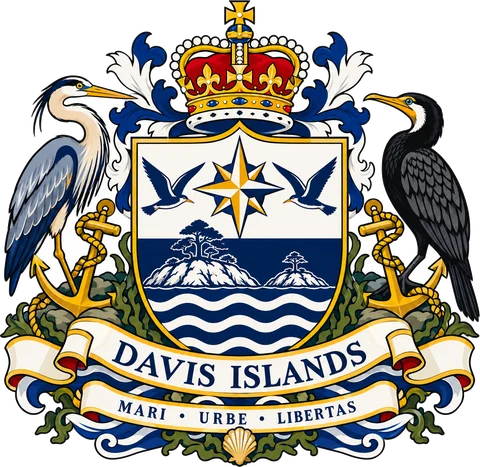
Constitution of the Commonwealth of the Davis Islands
Constitutional Instrument No. 001 of 2026 · Founded 8 October 2026 · Chimney Sweeps Islands
MARI · URBE · LIBERTAS
A constitution for a private, voluntary ceremonial association. No claim of sovereignty, public jurisdiction, or governmental recognition.
Preamble
We, the founding members of the Commonwealth of the Davis Islands, united in appreciation of maritime heritage, historical preservation, environmental stewardship, fellowship and civic tradition, establish this Constitution as the supreme internal governing instrument of our voluntary ceremonial association. Inspired by British constitutional traditions, and committed to liberty, dignity, equality, accountability and the rule of law, we recognize and respect the lawful authority of the United States, the State of New York and the City of New York. Our motto is MARI · URBE · LIBERTAS — By Sea · By City · By Liberty.
Article I — The Commonwealth
1. Establishment
The Commonwealth of the Davis Islands (“Commonwealth”) is a private, voluntary, non-sovereign ceremonial micronation and cultural association founded on 8 October 2026 at the Chimney Sweeps Islands, Bronx, New York.
2. Legal character
This Constitution governs only the Commonwealth’s voluntary internal affairs. It confers no sovereignty, ownership, public office, diplomatic immunity, legal nationality, or authority over nonmembers. Applicable law always prevails.
3. Purposes
The Commonwealth promotes maritime and local history, education, conservation, ceremonial traditions and lawful fellowship.
Article II — Ceremonial Geography
1. Founding islands
The Chimney Sweeps Islands are recognized as the Founding Islands.
2. Capital
Twin Island is designated the Ceremonial Capital and symbolic seat of the Honorary Governor-General. The land connection to Twin Island may be called “Governor’s Bridge” in Commonwealth publications.
3. Additional designations
Other locations may be recognized by proclamation for purely symbolic purposes. Historic place names and Indigenous heritage shall be respected. Orchard Beach is outside the Commonwealth’s ceremonial geography.
4. No property claim
Ceremonial designations confer no title, right to land, landing permission, public-access restriction, or authorization for structures, signage, or installations.
Article III — The Honorary Governor-General
1. Office
The Founder, ceremonially known as Matthew J., is the inaugural Honorary Governor-General and custodian of this Constitution.
2. Functions
The Honorary Governor-General represents the Commonwealth, maintains its archives, issues internal proclamations, convenes its Council, appoints ceremonial officers and assents to internal acts.
3. Limits
The office has no police, judicial, military, taxing, diplomatic or regulatory powers over the public. Reference to the British Crown is symbolic and does not imply endorsement or appointment by the Crown or United Kingdom.
4. Tenure
The inaugural holder serves until resignation, incapacity, death, or succession pursuant to Article XII.
Article IV — Commonwealth Council
1. Establishment
A Commonwealth Council shall serve as the advisory and deliberative body, with at least three members when sufficient volunteers are available. Members are appointed for renewable two-year terms.
2. Offices
The Council may include a Chief Minister, Secretary, Treasurer, and commissioners for Maritime and Environmental Affairs and Culture and Heritage.
3. Decisions
Ordinary resolutions pass by a majority of votes cast with a majority of serving members participating. The Council reviews internal acts, finances, membership policies and proposed amendments.
4. Transition
Until a Council is constituted, the Founder may exercise ordinary administrative functions, subject to the protections in this Constitution.
Article V — Voluntary Citizenship
1. Membership
Citizenship is voluntary honorary membership, not legal nationality or immigration status. Applicants must agree to this Constitution and published, nondiscriminatory membership criteria.
2. Rights
Members may express opinions, petition, participate in lawful activities, inspect published constitutional instruments, and resign at any time.
3. Duties
Members must respect applicable law, public access, wildlife, other persons and the non-governmental nature of the Commonwealth.
4. Documents
Ceremonial membership cards and certificates must state they are not government identification or travel documents.
Article VI — Fundamental Rights
1. Equality
Members shall be treated fairly regardless of race, ethnicity, nationality, religion, sex, sexual orientation, gender identity, disability or other protected characteristic.
2. Freedoms
Members enjoy freedom of belief and expression within reasonable rules against threats, harassment and unlawful conduct.
3. Fair process
Before suspension or expulsion, a member shall receive notice, a reasonable opportunity to respond, written reasons and access to an impartial review where reasonably available.
4. Privacy
Personal data shall be collected minimally, safeguarded and disclosed only with an appropriate lawful basis.
Article VII — Symbols and Ceremonies
1. Flag
The official ceremonial flag is the Davis Islands Red Ensign, a red field with the Union Flag in the canton and the crowned Davis Islands heraldic shield in the fly, as shown in the adopted design.
2. Arms and motto
The Commonwealth adopts its crowned heraldic arms with maritime imagery and the motto MARI · URBE · LIBERTAS.
3. Use
Symbols may be used at lawful private or permitted public ceremonies. They shall not imply actual governmental authority, and no permanent flag or sign shall be placed on public land without permission.
Article VIII — Environmental and Maritime Stewardship
1. Conservation
The Commonwealth shall encourage protection of coastal habitats, wildlife, historic sites and public shorelines.
2. Activities
Members shall comply with habitat restrictions, park rules and maritime safety requirements. Ceremonial vessels and organizations shall never impersonate government, law enforcement or emergency services.
3. Access
Commonwealth activities shall not obstruct lawful public access, interfere with emergency response, or disturb sensitive ecosystems.
Article VIII-A — Public Access, Legal Jurisdiction and Compliance
1. Jurisdiction
Twin Island, the Chimney Sweeps Islands, their shorelines and waters, and all other locations associated with the Commonwealth remain subject to applicable federal, New York State and New York City laws, rules, restrictions and jurisdiction. No ceremonial designation alters that authority.
2. Access
No member or visitor receives any special right of access, landing, occupancy, navigation or entry. All persons must obey applicable closures, posted restrictions, wildlife protections and property rules, including at Twin Island.
3. Law enforcement
Members participating in Commonwealth activities shall comply with lawful orders and directives of authorized officials acting within their powers, including federal law enforcement officers and United States Coast Guard personnel; New York State Police and other state officers; New York City Police Department officers; NYC Parks Enforcement Patrol officers and sergeants; Urban Park Rangers; and other authorized police, peace, conservation, park and maritime enforcement personnel.
4. Maritime law
All watercraft shall comply with applicable federal and state navigation rules, boating safety and equipment requirements, and lawful directions from authorized maritime officials. The Commonwealth flag conveys no governmental vessel status or navigational privilege.
5. Rights preserved
Nothing in this Article waives any person’s constitutional rights, rights to lawful review or remedies, or limits the lawful jurisdiction of public authorities.
6. Supremacy
In any conflict between this Constitution or a Commonwealth proclamation and applicable law, applicable law prevails.
Article IX — Finance and Property
1. Funds
The Commonwealth may accept lawful voluntary donations and contributions. Accurate records shall be kept and material financial activity summarized annually when funds are collected.
2. Accountability
No officer may misuse funds or bind another person to debt without authorization.
3. Property and currency
Property may be held only through lawful arrangements. The commemorative “Guano” is collectible ceremonial currency and not legal tender.
Article X — Proclamations and Internal Acts
1. Instruments
The Honorary Governor-General may issue numbered proclamations and internal orders consistent with this Constitution. The Council may adopt internal acts subject to assent.
2. Register
A public register shall record instrument number, title, date, issuing authority, text and effective date.
3. Hierarchy
No proclamation or internal act may override this Constitution or applicable law.
Article XI — Amendments
1. Procedure
After a Council is constituted, amendments require approval by two-thirds of serving Council members and assent of the Honorary Governor-General. Before that time, the Founder may adopt published, numbered constitutional amendments.
2. Entrenched principles
No amendment may authorize involuntary membership, unlawful discrimination, unlawful property occupation, or unauthorized exercise of governmental powers.
Article XII — Succession
1. Resignation and nomination
The Honorary Governor-General may resign or designate a successor by signed written instrument recorded in the constitutional archive.
2. Vacancy
If no successor is designated, the Council may elect an Acting Honorary Governor-General by a two-thirds vote, followed by a permanent appointment by the same threshold.
3. Continuity
A vacancy does not automatically dissolve the Commonwealth.
Article XIII — External Relations
1. Cultural relations
The Commonwealth may exchange correspondence and conduct lawful cultural activities with other voluntary associations and micronation projects.
2. No official status
It shall not claim recognition, diplomatic privileges, or endorsement by the United Kingdom, United States, New York State, New York City or NYC Parks.
Article XIV — Dissolution
1. Procedure
The Commonwealth may dissolve by written proposal, approval of three-fourths of serving Council members, and publication of a dissolution instrument. Before a Council exists, the Founder may dissolve it by signed declaration.
2. Assets and archive
Lawful obligations must be satisfied; remaining assets shall be disposed of according to applicable law, preferably benefiting conservation, history or education. Archives should be preserved where practicable.
Article XV — Ratification and Commencement
1. Adoption
This Constitution takes effect only when the Founder signs and dates the Instrument of Ratification below.
2. Continuity
Prior ceremonial symbols and declarations remain recognized insofar as consistent with this Constitution.
3. Future instruments
The Honorary Governor-General may issue Proclamation No. 002 of 2026 concerning Twin Island and Governor’s Bridge after ratification.
Instrument of Ratification
By my authority as Founder and inaugural Honorary Governor-General of the Commonwealth of the Davis Islands, I adopt this Constitution as its foundational internal governing instrument and pledge to uphold its principles, protect the rights of its voluntary members, and respect the laws and public authorities having jurisdiction over the lands and waters celebrated by the Commonwealth.
Matthew J.
Matthew J.
Founder and Honorary Governor-General
Commonwealth of the Davis Islands
Date of ratification:
Ceremonial signature (facsimile; not a verified handwritten signature). Official ceremonial seal: Coat of Arms of the Davis Islands.
MARI · URBE · LIBERTAS