
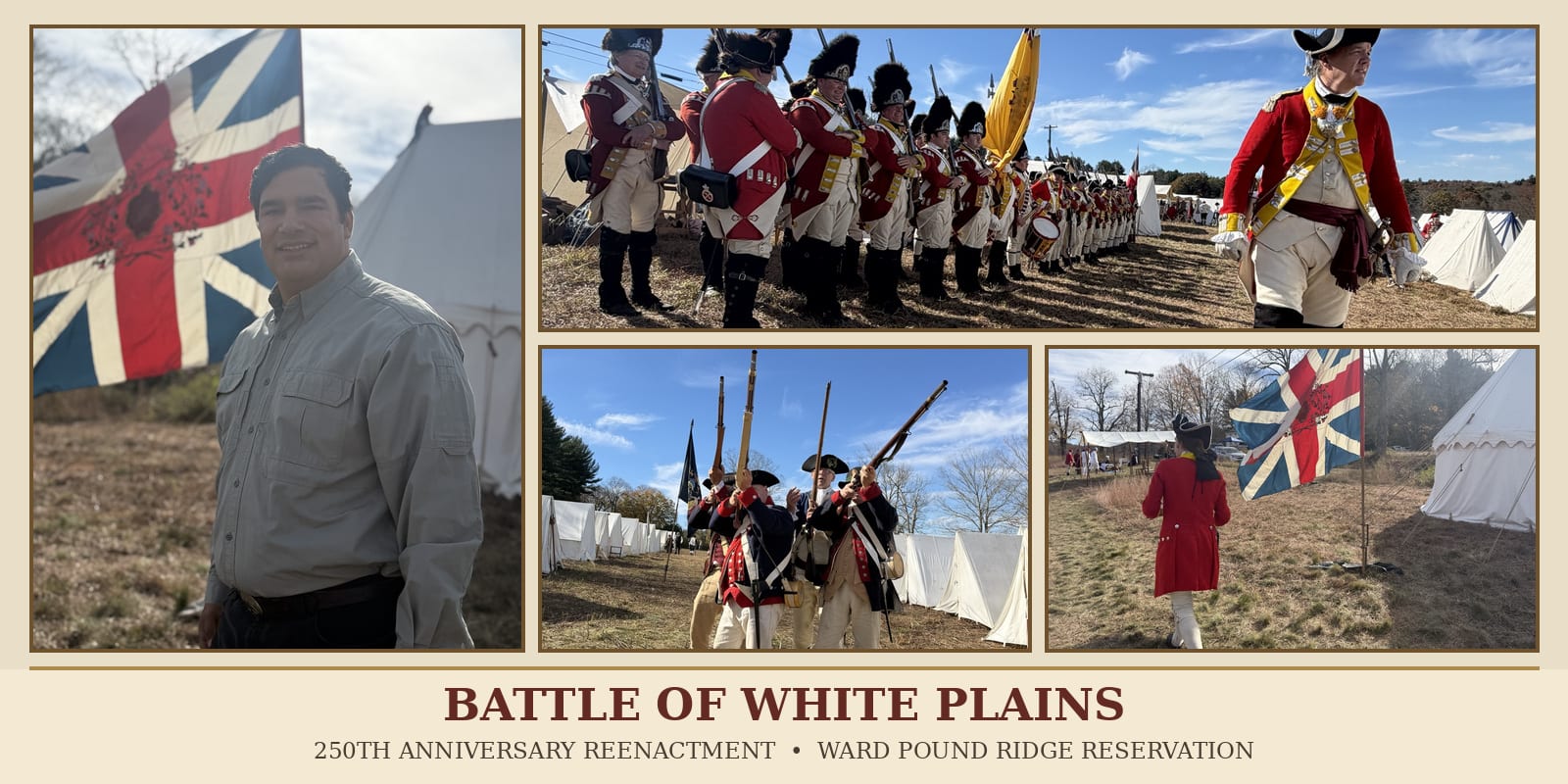
On Saturday, October 24, 2026, Honorary Governor-General Matthew J., founder of the Commonwealth of the Davis Islands, attended the 250th anniversary reenactment of the Battle of White Plains at Ward Pound Ridge Reservation in Westchester County, New York.
The commemorative event brought together historical reenactors portraying British Crown forces, Continental Army soldiers, Loyalists, and other participants in the American Revolutionary War.
Visitors experienced 18th-century military history through period encampments, historical uniforms, musket demonstrations, military formations, and interpretations of the events that shaped the American Revolution.
For the Honorary Governor-General, whose personal interests include British military heritage, maritime traditions, and American history, the occasion provided an opportunity to engage with historical organizations dedicated to preserving this important period.
From Pell's Point to White Plains: The British Advance of 1776
The Battle of White Plains was not an isolated engagement. It followed a series of British military operations intended to outmaneuver General George Washington's Continental Army during the New York Campaign of 1776.
On October 18, 1776, British forces under General Sir William Howe landed at Pell's Point, located in what is now Pelham Bay Park in the Bronx.
The British advance was met by approximately 750 American troops commanded by Colonel John Glover of Massachusetts.
Using stone walls and the surrounding terrain, Glover's men conducted a disciplined delaying action against a significantly larger British and Hessian force.
Although the American troops eventually withdrew, their resistance helped provide Washington with valuable time to move his army northward toward White Plains.
This engagement holds particular historical significance for the Commonwealth of the Davis Islands because Pell's Point lies within the coastal landscape of modern-day Pelham Bay Park, near the Long Island Sound waters that inspired the Commonwealth's ceremonial identity.
The Battle of White Plains — October 28, 1776
Following the fighting at Pell's Point, British and Hessian forces continued their advance through Westchester County.
General George Washington established defensive positions around White Plains, seeking to preserve the Continental Army while resisting the British movement northward.
On October 28, 1776, British and Hessian troops attacked American defensive positions, with significant fighting taking place at Chatterton's Hill.
American soldiers, including Continental troops and militia, mounted determined resistance against the advancing British forces.
However, the British and Hessian attacks eventually forced the American defenders to withdraw from the hill.
The engagement resulted in a British tactical victory.
Nevertheless, Washington successfully preserved the greater part of his Continental Army, withdrawing rather than allowing his forces to be decisively destroyed.
The survival of the Continental Army remained essential to the continuation of the American struggle for independence.
The Battle of White Plains remains an important chapter in the military history of New York and the wider American Revolution.
An Invitation from the 23rd Royal Welch Fusiliers
During the anniversary commemoration, the Honorary Governor-General had the pleasure of meeting historical reenactors portraying soldiers of the British Crown.
Of particular significance was an invitation extended to Matthew J. by members of a historical reenactment organization representing the 23rd Regiment of Foot, the Royal Welch Fusiliers, to consider joining their regimental reenactment group.
The invitation was warmly received and reflects the Honorary Governor-General's longstanding personal interest in British regimental history, military ceremony, and living-history traditions.
The historic Royal Welch Fusiliers were among the distinguished regiments of the British Army, with a heritage extending to the late 17th century.
Historical reenactment organizations provide opportunities to study period military uniforms, regimental customs, equipment, battlefield tactics, and the experiences of soldiers who served during the American Revolutionary War.
The invitation was extended in a personal historical-reenactment capacity and does not constitute a formal affiliation between the Commonwealth of the Davis Islands and any military organization.
Preserving History Through Living Heritage
The Commonwealth of the Davis Islands recognizes the educational and cultural importance of historical reenactments and living-history programs.
Such events allow the public to examine history from multiple perspectives, including those of British regulars, American revolutionaries, Loyalists, and civilians whose lives were affected by the conflict.
The Commonwealth's British-inspired ceremonial traditions reflect an appreciation for historical institutions, maritime heritage, heraldry, and military pageantry, while its cultural activities encourage a broader understanding of the shared history of Britain and the United States.
The Honorary Governor-General extends his appreciation to the historical reenactors, organizers, and interpreters whose dedication contributed to the 250th anniversary commemoration.
As the 250th anniversary of the Battle of White Plains approaches on October 28, 2026, the Commonwealth joins history enthusiasts in recognizing the importance of preserving and understanding the events that helped shape the United States.
MARI · URBE · LIBERTAS
By Sea · By City · By Liberty
Ceremonial Status Notice
The Commonwealth of the Davis Islands is a private ceremonial micronation project. The Honorary Governor-General's attendance at the historical reenactment was undertaken in a personal capacity. The Commonwealth is not affiliated with or recognized by the United States Government, the United Kingdom, or any military organization.